
Ashby museum has an archive of over 3000 photographs – both original and copies. This page allows people to view the main group of photographs, but does not include photographs in specialist collections as these often include ones that are not in our primary area of interest. Larger images may be viewed at the museum during opening hours, and copies for private use may be purchased.
This page also allows access to details of artefacts (physical objects) held by the museum. Please note that when changing between photographs and artefacts, the classification list is only updated after the first search.
Showing images 3471 to 3480 of 4081
AYZMU:P09-0531
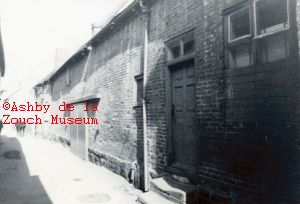
1920 - 1929 (circa)
Mill Lane, looking towards North Street. View of right hand
side. Possibly taken in 1920's.
AYZMU:P09-0530
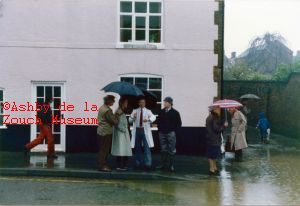
1985
1985 flood at the junction of Mill Lane and North Street,
outside No.26 North Street. Gentleman with umbrella on left in
Peter Court.
AYZMU:P09-0529
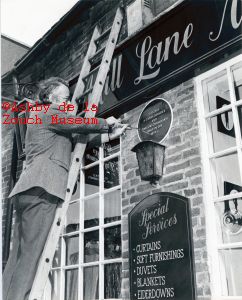
1983 - 1987
Clive Jones attaching a "blue plaque" to the outside wall of
Mill Lane Mews Dry Cleaners after the redevelopment of the Mews.
Building was originally a tallow chandlers shop in 18th.
century.
AYZMU:P09-0528
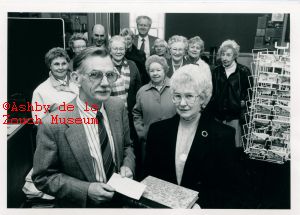
1988 - 1989
Presentation at Ashby museum to David Jackson. Cheque being
received from Townswomens Guild.
AYZMU:P09-0527
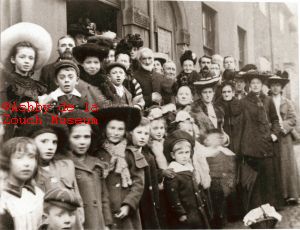
1906
Children and worshippers outside the Primitive Methodist Chapel
in Mill Lane Mews. They built a chapel in 1933 in Millbank, and
in 1862 purchased the old Baptist chapel in Mill Lane Mews.
worshipped there for the last time before moving again to New
Burton Road in 1906. Building still in use by C.J.Lewis
(printers)
AYZMU:P09-0526
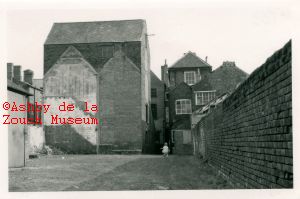
1966
Demolition of buildings at the rear of No.73 Market Street,
Simpkins and James (grocers)
AYZMU:P09-0525
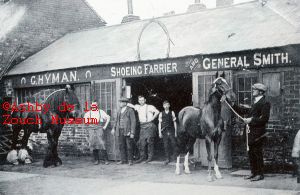
1930 - 1939
Premises of G.Hyman, shoeing farrier and general smith. Staff and horses outside the side of premises which at that time were in Derby Road. In 1936 it is known he was operating out of these premises and also premises opposite entrance to North Street car park - building later became "Affordable Antiques", then a hairdressers.
AYZMU:P09-0524 image 1 of 2
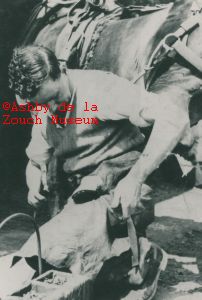
1947 - 1955
Farrier and blacksmith shoeing a horse outside his premises
which were opposite entrance to North Street car park. ?name -
was he a Hyman? Building later became "Affordable Antiques",
then a hairdresser. Also had premises in Derby Road in the 1930's.
AYZMU:P09-0524 image 2 of 2
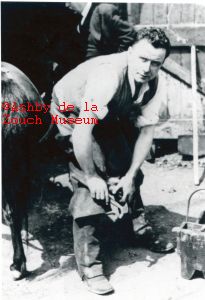
1947 - 1955
Farrier and blacksmith shoeing a horse outside his premises
which were opposite entrance to North Street car park. ?name -
was he a Hyman? Building later became "Affordable Antiques",
then a hairdresser. Also had premises in Derby Road in the 1930's.
AYZMU:P09-0523
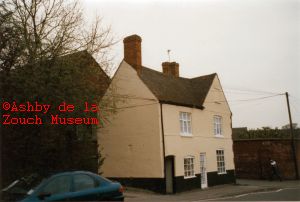
1980 - 1984
No.9 Mill Lane (Kathys Corner Crafts) and No.26 North Street
(offices). Published details are: Though outwardly the
brickwork of this small L-plan brick building with tiled roof is
manifestly of a 19th century date, its location at the north end
of a burgage plot that originally ran through from Market Street
and alongside Mill Lane, may indicate an early subdivision of a
burgage plot alongside an important thoroughfare. The footprint
plan of the building consists of two bays lying parallel to Mill
Lane and a further two bays overlooking North Street. A
centrally located chimney, set within the fabric forming the
junction between the two ranges of buildings, suggests there
were fires at ground floor level while the upper chambers were
dependent on ambient heat through the chimney stack. Teh
shorter, easternmost bay with an entrance passage running
through the building at ground floor appears to have been added
at a later date. This suggests the original plan of the
building was of two bays, lying alongside Mill Lane and single
bay lying alongside the present North Street, which was
originally a Back Lane. This L plan whihc clusters the
fireplaces at the re-entry angle of the building is a
characterstic lowland plan of the late medieval and
post-medieval period. Internally the building contains
substantial evidence of oak timbers being used for the floor
frame between ground and first floor, most of which still
survives. The brickwork of the Mill Lane elevation bears
testimony to several alterations and repositioning of windows.
The fabric of the present building appears to be 19th century in
origin but the plan form and floor frame suggest the core of an
earlier building has been assimilated to create the present
building. Though modest in form, No.26 North Street appears to
be the earliest surviving example of occupation of the backlands
of a burgage plot."